Over my lifetime on the water, I have seen many changes take place, but in the past ten years, up to now, nothing is what it was, so we need to adapt.
Now that spawning is over, snapper move right up into the inner gulf to feed on bait fish and shellfish to rebuild their fat reserves and condition. Traditionally, snapper feed up in channels where there is current, then move on up into shallow water in the harbours and estuaries. This year, snapper appear to be moving through the channels quicker than I can recall, but once out of the channels, they spread out on the open sand grazing like brown cows. This is the reason most of you report just a few fish showing on the sounder, whereas before and during spawning, they were in large schools.
Remember that the actual footprint of what you are seeing is quite small, liken it to a torch beam shining on a wall. Up close, the centre of the beam is small, but as you walk backwards, the beam widens. In ten meters, the actual bottom showing may only be a meter wide, so when looking for a sign, I slowly zig-zag into the current building, up a picture in my mind as to how many fish I see.
On the last three trips, I struggled to find any volume of fish, just scattered marks. At anchor, I set the burley and ground bait out the stern, as this will sink and cover a greater drawing in the fish that are well spread out, whereas if set close to the bottom, the coverage is way less.
Often, it may take half an hour before the fish come on the bite, so use this time to catch fresh bait. Pillies and Squid are all good bait, but think about what the fish are feeding on: shellfish, shrimp and small bait fish. This is why you will get the bait coming back in shreds: it’s not just small fish; it’s the way they feed till the ground bait and burley draw in more fish, and that’s when they become competitive and aggressive when taking the bait.
Fresh bait, such as jack or slimy macs, holds on the hook way better than a soft pilchard, so the fish become aggressive, demolishing it, giving you a far better hook-up rate. Apart from the channels where there is a current, I will use a tiny ¼ oz sinker just to get the bait down, but as the tide drops off, I remove the sinker so when a fish picks up the bait, there is no resistance, and you can see any line movement. Cast as far away from the boat and slowly let the bait sink back into the burly trail. Keep the rod tip low and watch and feel for any line movement. Strike hard and fast, but wind at the same time to take out slack line so the hook stays set.
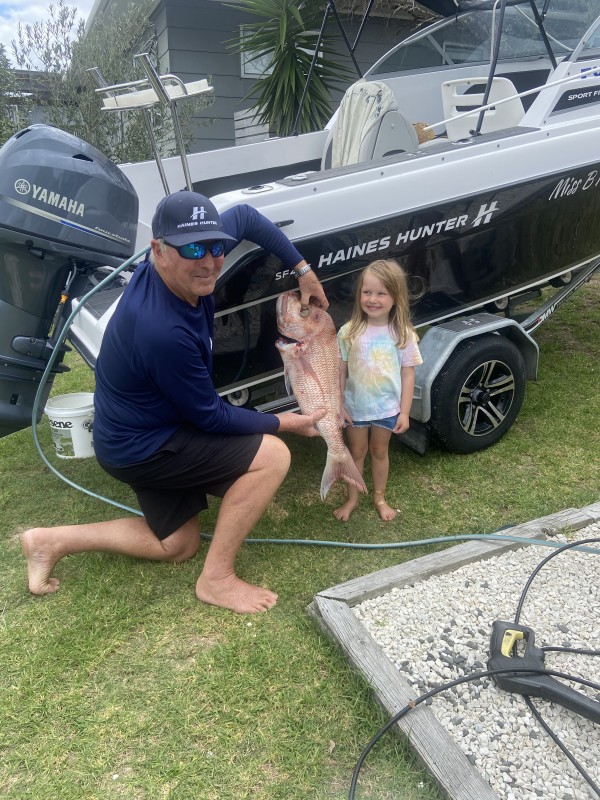
The trip before last, I anchored in 12 meters on open flat sand with very little sign showing on the sounder, two rods, bait and set, thinking I was going to have a quiet coffee till the fish came on the bite. Wrong, each rod went off and within 30 minutes I had a limit and back at the house by 8.30.
Last weekend, going out over the same ground, there were even fewer fish showing, so I decided to head out to around 22 meters, but again, there were even fewer fish showing. Practice what you preach. Once anchored, two big unweighted baits were cast out, one directly astern and the other out around mid-ship, so it would cover more ground as the slight current took it back behind the boat.
It took around half an hour before the first rod got hit, but being too excited, I did not wind down to take in the line stretch and slack line. Rebaited and got the same result again, so now I had learnt how they were feeding and to give them a bit of slack line. Then, with the rod tip pointing to the water, I waited till the line came up tight. With six adults and two ravenous grandkids to feed, I kept four snappers on one that I would normally have released.
As I have described, most bait fishermen I have spoken to in the past three weeks have found the fishing to be the same, but I suspect that when the water cools a bit, the fish will be more aggressive on the bite.
All reports I get have been that the fish are smaller than usual, mostly between 29-35 cm, but the bigger fish are being caught at the change of light, close in around the rocks at Rakino and Noises. Take a look at the channel between the South Island and Awash Rock. This spot has always produced good fish on an outgoing tide with a southwest to west wind, well worth putting down a line bait, as I often pick up some good-sized king fish here at this time of the year.
Closer to Auckland slowly steam into the current once in 12 meters from Rangitoto light outwards A buoy, this area has been fishing well on the incoming tide especially on dusk.
Despite the weather being a bit average at times this summer, take every opportunity to get out on the water for some quality time with family and friends.